It’s a common misconception among students that proofreading and editing are two words meaning the same, as if they were each other’s synonyms. It’s understandable, both involve reading over your work and making it better, right? Well, sort of. But treating them as the same thing is one of the most common reasons that students lose marks over silly mistakes, regardless if their arguments were accurate.
This blog will serve as a guide to students looking to find the difference between editing and proofreading.
They Are Two Different Stages, Not Two Words for the Same Thing
Here’s the simplest way to think about it:
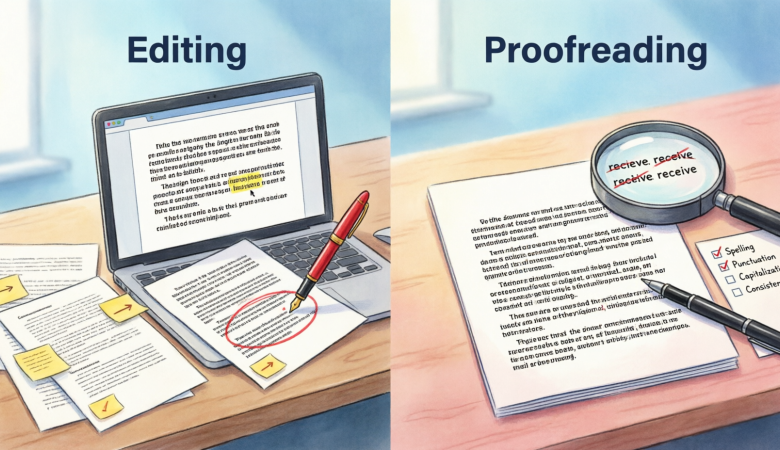
Edit
This stage involves more than just checking for grammar. This step is crucial to look at your work as a whole and assess if it is delivering what is was required to. Is the argument clear? Does the structure make sense? Are there sections that drag or feel underdeveloped? Is the tone consistent throughout? Editing happens at the level of ideas, logic, and organization.
Proofread
Proofreading is about the fine detail. It comes after editing, after you’re satisfied that the structure and argument are solid, and it’s the process of catching the small stuff.
- Spelling errors.
- Punctuation mistakes.
- Grammar issues.
Such errors don’t affect the argument, but impacts your credibility negatively. It makes the reviewers take the impression you just did not care enough about your work.
Do one without the other, and you’re only doing half the job.
What is Editing Really About
The mindset you had while writing is totally different than the mindset you need to have when editing. In the phase of writing, you are still creating ideas and content. Editing is critical; you’re evaluating what came out and deciding whether it holds up to the requirements and academic standards.
Editing can mean you may have to rephrase entire paragraphs to make the structure flow more seamlessly. Editing can also mean removing some content that, on reflection, doesn’t contribute to the main argument. It might mean realizing that your introduction promises something your conclusion doesn’t quite deliver, and fixing that mismatch. It’s also the stage where you check that your argument is supported by evidence throughout, not just in certain sections.
Scholars likely feel tired by the end of it, so they skip editing. They feel like they have already put in a lot of effort writing it, so why would they erase and write again? But the students whose work consistently scores well understand that the first draft is just the starting point. This is also why many students look for an assignment helper not to do their assignments, but to polish and refine them before submission. Real writing happens in the edit.
What Proofreading Actually Involves
Proofreading is the final step to finalizing your draft. By the time you’re proofreading, you’re not questioning whether the argument works; you’re just making sure the writing itself is free from errors.
This means reading slowly. More slowly than feels natural. Many experienced writers read their work aloud during proofreading because it forces them to process every word individually rather than skimming over familiar content. Your brain is remarkably good at seeing what it expects to see rather than what’s actually on the page, which is why errors that feel invisible to the writer jump out immediately to a fresh reader.
- Common things to catch during proofreading include:
- Words that are spelled correctly but used wrongly (their/there/they’re is the classic example)
- Missing or doubled words, inconsistent capitalization
- Punctuation that doesn’t match the sentence structure, and referencing errors.
None of these are intellectually significant mistakes, but they all cost marks, and they’re all avoidable.
Why the Order Matters
This is where a lot of students go wrong. They proofread before they edit, or they try to do both at once, and neither gets done properly as a result.
If you proofread a paragraph that you later restructure or cut entirely, you’ve wasted that effort. Worse, focusing on surface corrections too early can give you a false sense that the work is finished when the deeper structural issues haven’t been addressed yet.
The correct sequence is always: write, then edit, then proofread. Draft first. Fix the structure and argument. Then clean up the surface. In that order, every time.
When to Consider Outside Help
Sometimes, no matter how carefully you read your own work, you can’t see its problems clearly. That’s not a personal failing; it’s just how familiarity works. When you’ve been staring at the same document for days, your brain stops processing it objectively.
This is where professional proofreading services can make a real difference. A trained proofreader brings fresh eyes to your work and catches things you’ve become blind to, not just typos, but inconsistencies in formatting, awkward phrasing that’s become invisible through familiarity, and referencing errors that seem minor but can affect your grade. For important submissions, dissertations, final year projects, and long essays, having a professional review your work before you hand it in is a genuinely worthwhile investment.
A Practical Checklist for Students
If you want a simple framework to use for your own submissions, here’s one worth keeping:
Editing checklist:
- Does the introduction clearly set up what the work will argue?
- Does each paragraph have a clear point that connects to the overall argument?
- Is there sufficient evidence for every major claim?
- Does the conclusion reflect what the body of the work actually argued?
- Are there any sections that could be cut without losing anything important?
Proofreading checklist:
- Are there any spelling errors, including correctly spelled but wrongly used words?
- Is punctuation consistent and accurate throughout?
- Are there any missing or repeated words?
- Is the referencing style applied consistently?
- Does the formatting meet the submission requirements?
Work through both lists separately, editing first, proofreading second, and your submissions will be noticeably stronger for it.
Conclusion
Editing and proofreading are not the same thing and scholars looking to ace their submissions need to start treating them differently as well. Both steps are different but equally important to making your writing perfect. While one makes sure what you wrote is up to the requirements, the other helps you polish it. Without either, you will have a poorly written draft regardless of the strength of arguments made.