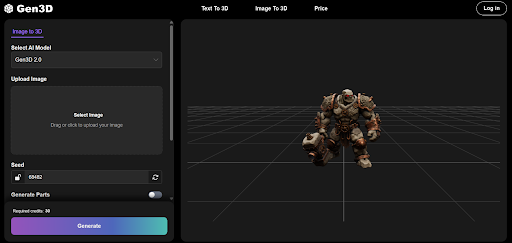
Against the backdrop of continuous upgrades in generative AI, image to 3D model generation is becoming a new focus in the field of visualization.
Picture your pet and in a short time you will have an animated 3D image of your pet right in front of you, showing your pet’s hair down to the finest detail.
This isn’t just something we think about in the future anymore; it’s beginning to change how people are now interacting with their world through technology.
Basic Science Popularization on Image to 3D Technology
To put it simply: The main purpose of Image to 3D is to “restore” an ordinary image in 2D into the equivalent of a 3D model with depth. This involves many AI algorithms and graphics processing technologies.
Although it looks like science fiction, it is actually the result of the combined effect of AI and computer vision.
Picture this; you snapped a shot of a vintage wooden chair, and in mere seconds the system created a virtual 3D image of that chair with 360 degrees of freedom. Now you can see the actual orientation of the grain pattern of the wood and every sign of wear to that vintage piece.
Photogrammetry is a way to develop a three-dimensional model using the method of developing spatial structure and reconstructing three-dimensional objects using multiple photos of the same object from different angles. A good way to think of this is “creating a three-dimensional world from images,” but in this case the entire process has been automated by the algorithm.
The system uses AI and machine learning to fill the missing parts from images so that 3D reconstruction will have a higher level of completeness and accuracy.
This is not only a technological breakthrough but also opens up another avenue for the artistic community by creating what could be likened to making traditional sculptures from digital images using code and algorithms.
Why Is This Trend Erupting Now?
When we consider the reasons for the significance of this technology at this time, we are exploring the simultaneous growth of computational capacity and algorithmic systems.
In the past few years, continued development of hardware capabilities and optimization of software toolchains have made it progressively possible to conduct the complex processes associated with converting images to 3D (3D reconstruction) on a large scale. More specifically, the rapid growth of GPU architecture has allowed for increased efficiency in the area of parallel computing which has reduced the time necessary to perform the previously extremely lengthy processes involved in 3D reconstruction and rendering.
Furthermore, artificial intelligence technologies that are used to perform visual perception and complete information gaps are continually becoming more capable at enabling systems to infer spatial arrangements of volumes of three-dimensional space, thereby enhancing both the accuracy and stability of 3D objects.
These technologies have developed synchronously, which has helped to drive the rapid maturing of this space.
Industry Penetration And Application of Image to 3D Technology
The image to 3D or text to 3D is showing significant potential for usage and has a rapidly developing trajectory. Their reach is also extending throughout various industries. This is similar to when you add a brand-new capability module to an existing system and therefore improve both productivity and creativity overall. Below we will discuss and analyze several key areas of application where this type of conversion has already been implemented and where it is continuing to grow.
Application Area 1: Gaming and Interactive Entertainment
Through the use of image-to-3D solutions, the creation of content has become much less difficult in both the gaming industry and the interactive entertaiment industry. Developers have the ability to efficiently create 3D assets straight from actual images to be used in creating game scenes, character models, or virtual props. Both will continue to shorten the time required for production as well as produce more enriched and realistic visual content.
Application Area 2: E-commerce and Digital Retail
In the field of eCommerce, technology exists that allows quick transformation of 2D Images to Rotatable 3D Models so that customers can examine products from various angles. A more realistic way of presenting products helps customers make decisions more efficiently, thus making for a much better shopping experience overall.
Application Area 3: Film and Animation Production
For both the film and animation industries, this same technology can also be used to assist in rapidly creating basic models of props and scenes or even character models thus dramatically reducing the time required for pre-production modeling processes as well as providing an additional source of visual effects production’s base materials, making production processes more adaptable.
Application Area 4: Industrial Design and Manufacturing
In industrial design, the technology allows designers to rapidly produce editable 3D models of actual product photographs for use in performing structural analysis and developing plans for improvement. In manufacturing, as a result of this, the time it takes to go from concept to prototype is decreasing.
Application Area 5: Education and Research
Image to 3D technology can also be employed in education and research to visually illustrate abstract or complicated structures like biological organs, historical artifacts or engineering structures. This type of visual representation of structures enhances the ability of individuals to comprehend and learn as well as broadens the ways in which research findings can be expressed.
Advantages of AI 3D
1. Significantly Reduced Modeling Costs
Because of how labor-intensive and monetarily draining the creation of traditional three-dimensional graphics is, when developing a model, the majority of people rely heavily on using manual techniques in order to piece together each detail. However, now that we have the introduction of AI 3D technology into our fields, we will no longer have to suffer through the slow and cumbersome process of building 3D designs through the use of manual techniques.
2. Greatly Improved Content Generation Efficiency
With the help of advances in neural networks and automated reconstruction algorithms, AI is capable of reconstructing the three dimensions of an extremely complicated object in a matter of seconds or minutes, compressing a task that used to take anywhere from multiple hours to several days down to mere seconds or minutes and significantly shortening the entire modeling process.
3. Lowered Technical Barriers
In the past, someone had to have a high level of technical expertise in order to utilize computer modeling programs. With the advent of AI-generated 3D models, the only requirement to utilize this technology will be to have image-based source inputs (for example, a photo). This allows more people without any technical experience to be able to create their own custom, three-dimensional models.
4. Enhanced Realism and Sense of Realism
With AI technology being so advanced, AI has quickly become a leader in providing high-quality textures and real-world detail to create 3D models that more closely represent physical objects. This results in more photorealistic and organic looking virtual content which makes it ideal for applications ranging from electronic entertainment to everyday use in the retail e-commerce marketplace.
5. Supports Rapid Deployment Across Multiple Industries
From gaming and film to industrial design and education, AI 3D is able to easily adapt to meet the demands of each hypothetical situation and provide the different types of industries with customizable, flexible 3D content solutions that can be created utilizing the latest in advanced technologies.
6. Drives Upgrades in Digital Content Production Methods
AI 3D is not just an enhancement of existing tools but stands for a radical change in how we produce digital content through a process called data-driven generation instead of manual 3D modeling. With AI 3D will be creating the entire digital construction process more automated and intelligent.
Conclusion: Towards a More Three-Dimensional Digital Future
The integration of image-to-3D technology into workflows across many industries is transitioning from theoretical to practical. The technology has the potential to do more than increase efficiencies; also, provide new avenues for communication and interaction.
Development efforts are continuing to move beyond the challenge of accuracy and the cost of computational resources into establishing standards and/or optimization through advances in algorithm and computing power — which will, over time, create an evolving ecosystem where AI 3D is not simply an innovative technology based on tool use, but a critical component of the digital landscape.
Long term, we may have an intuitive, immersive, and true-to-life relationship with digital content.